The Southampton Old Town Walk: Every Gate, Tower and Memorial
The short answer
Southampton's medieval wall ran 2,200 yards with twenty-nine towers and eight gates. Thirteen towers and six gates survive, and roughly half the circuit is still standing. Walk it anticlockwise from the Bargate: High Street, Holyrood Church, Bugle Street and Tudor House, then Western Esplanade for the best-preserved stretch, the Mayflower Memorial and God's House Tower, finishing at Town Quay. Ninety minutes, free, and a guided Southampton city tour runs from From $31.
What you are actually walking round
Southampton got rich on wool going out and wine coming in, and that made it worth attacking. Rampart defences were begun around 1202 and rebuilt in stone through the 14th century against French raids, and what you can walk today is the result. It is one of the more complete medieval town walls in England, and it sits inside a modern shopping city.
The circuit is not a loop you can follow unbroken. Chunks went in the early 20th century for a police station and in the 1930s for the trams and the traffic. What follows is the order that gives you the most standing wall for the least backtracking.
1. The Bargate
Start here, because both guided walks do and because it is the piece everyone recognises. The Norman core was built somewhere between 1180 and 1200 as a two-storey stone gate tower and the principal northern entrance to the walled town. In the late 13th century it was extended, gaining the two drum towers and the large first-floor hall.
Look at the north face: shields, arrow slits, and two lions flanking the arch. That is the side that faced whoever was coming. The Bargate and the walls together are protected as a Scheduled Monument.
2. South down the High Street
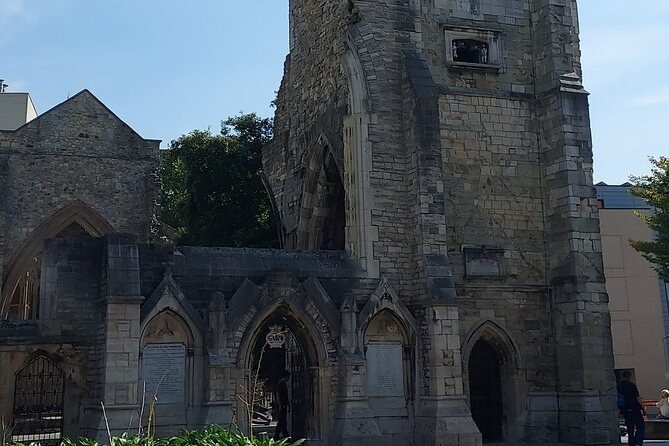
Modern shopfronts, and then a roofless church in the middle of them. Holyrood Church stood on the corner of Bernard Street and the High Street from the Middle Ages until an air raid in November 1940 burnt it out. The spire and the Victorian work went; the tower and the medieval chancel held.
It was never rebuilt. It was rededicated as the memorial to the Merchant Navy, and there is a Titanic crew memorial inside it. Five minutes, free, and it is the stop most visitors walk straight past.
3. West into Bugle Street for Tudor House
A timber-framed merchant's house with a garden behind it, and the oldest museum in the city. Adult admission is £10.00 and the ticket lasts a year; it opens Monday to Thursday 10am to 3pm and weekends 10am to 5pm, and it is closed all day Friday.
Even from the street it is worth the detour, because it tells you what the walled town looked like when the walls still mattered. Bugle Street itself is the best-preserved street inside the circuit.
4. Western Esplanade: the best of the wall
This is the stretch to walk if you only walk one. The wall here faced the water, which is why it survived when the landward sections did not, and it runs almost continuously with arcading and towers along it. You are walking along what used to be the shoreline; the ground to your west is reclaimed.
5. The Mayflower Memorial
On Western Esplanade, marking the sailing of the Mayflower and the Speedwell from West Quay on 15 August 1620. The Speedwell leaked, both ships put back to Dartmouth and then Plymouth, and the Mayflower crossed alone — which is why Plymouth gets the credit and Southampton gets the column.
R M Lucas designed it and it went up in 1913: a rough stone column on five stepped stages under a domed cupola, with a bronze model of the ship on top. Grade II listed, and a stop on both walking tours.
6. God's House Tower and Town Quay
The south-eastern corner of the circuit, where the wall met the water. God's House Tower is a medieval gate and tower that has been a gunpowder store, a prison and a museum, and is now an arts venue. From outside it costs nothing and it completes the shape of the town in your head.
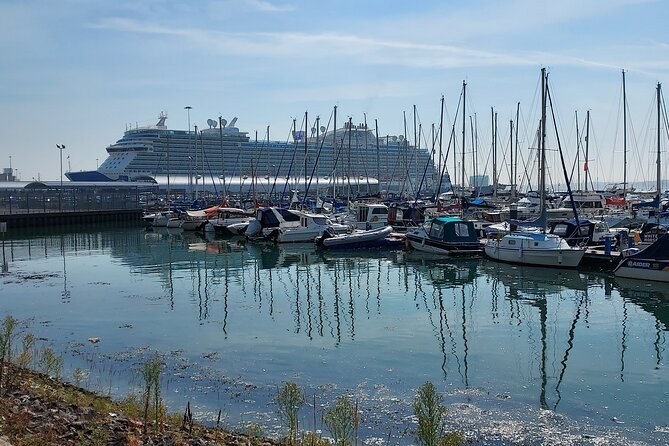
Town Quay is where you finish, and it is the point of all of it: the water the wool and the wine and eventually the liners went out on. The Titanic walking tour starts from here rather than ending here, which is a defensible choice in the other direction.
What survives, and what did not
| Feature | Built | Surviving |
|---|---|---|
| Towers | 29 | 13 |
| Gates | 8 | 6 |
| Circuit length | 2,200 yards | About half still standing |
The losses are recent rather than medieval. The section west of the Bargate went in the early 20th century to make room for a police station, and the section east of it in the 1930s when trams and traffic needed the width. Only very short stubs remain attached on either side of the gate itself.
Why the wall looks different on each side
Walk the circuit and you will notice that the western stretch is tall, continuous and elaborate, while what survives to the north and east is fragmentary. That is not weathering. It is what the town was defending against, and when.
The western wall faced the water, which was where a French raiding force would come from, and it was rebuilt in stone in the 14th century as a serious military structure. It had to be: the ground behind it held the merchants, the wine vaults and the wool. Several of those vaults are still under the modern street.
The northern and eastern walls faced land and a friendlier prospect, and they were the first to be sacrificed when the modern city needed the room. The section immediately west of the Bargate went in the early 20th century for a police station, and the section east of it in the 1930s for trams and traffic. Only short stubs remain attached to the gate itself, which is why the Bargate now stands almost free.
The practical consequence for a walker is simple. Give the western half of the circuit most of your time and treat the rest as connective tissue. That is also why both guided routes spend so much of their ninety minutes between Bugle Street and Town Quay.
Doing it with a guide
Ninety minutes on your own covers the route above comfortably. What the guided versions add is the reason each thing is where it is, and both start at the Bargate or Town Quay rather than expecting you to find your own way in.
- The private walk from From $30, led by a history doctorate or a trained specialist, at whatever pace suits you, and guided in Spanish as well as English.
- The Titanic walk from From $21, two hours on a fixed 10am or 2.30pm departure, eleven stops, ending with a pub discount.
The two overlap on the ground and differ completely in what they are about. Full detail on each is on the walking tours page, and the Titanic addresses have a page of their own.
If you only have forty minutes
Bargate, High Street, Holyrood Church, and then straight down to Western Esplanade for the wall. Skip Tudor House, skip Town Quay, and turn back when you reach the Mayflower Memorial. That is the medieval town at speed, and it is still better than a shopping centre.
Half a medieval town is still standing here and it takes ninety minutes to walk. Both guided versions of the route are compared on Southampton Tours, and either one is cheaper than the taxi you would take instead.
Guided versions of this route
Private Walking Tour of Southampton
The highest-rated walk here, led by a historian, at whatever pace suits you.
From $30 per person
Check Availability
Southampton: Secrets of the Titanic Guided Walking Tour
Eleven Titanic stops in two hours on foot, for the price of a round of drinks.
From $21 per person
Check Availability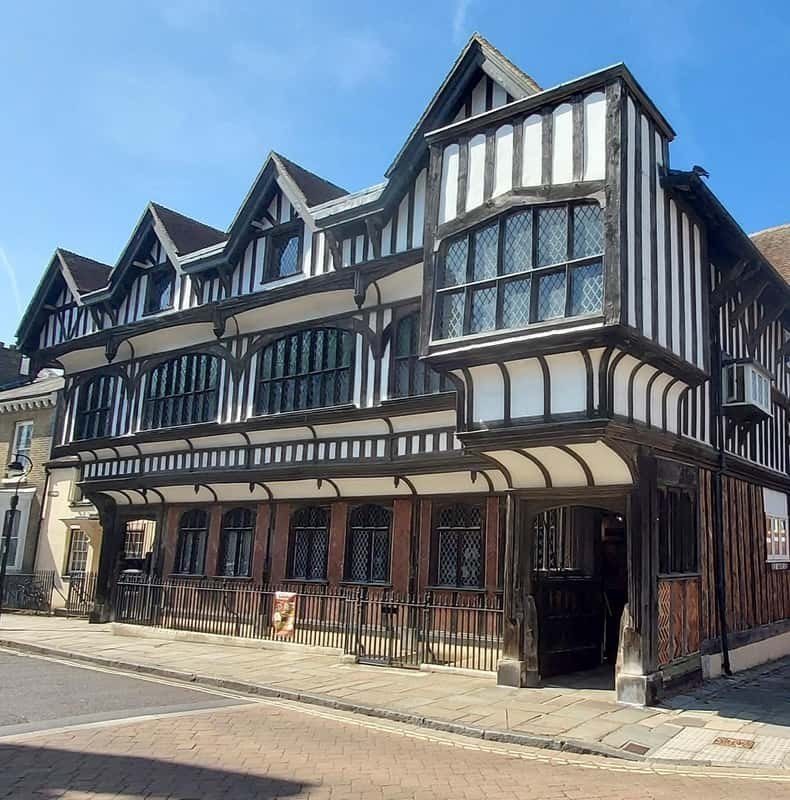
Private Southampton Walking Tour
Ninety minutes with a guide to yourselves, in English or Spanish, from the Bargate.
From $31 per person
Check Availability